

Assessment staff are expected to produce statistically sound values and explain them under scrutiny—with backgrounds in appraisal, not statistics. That gap doesn’t show up on an organisation chart. It may, however, show up at an appeal. But you shouldn’t need a Statistics degree to generate or explain assessment values.
Ask almost any assessment office how many people on staff have formal statistical training, and the honest answer is usually “not enough.” That’s not a hiring failure. Appraisal has never been viewed as a statistics job — it’s built around understanding property, neighborhoods, construction, and market conditions. But the work is increasingly complex as offices generate values through mass appraisal processes, predictive models and use ratio studies to determine fairness and equity. Explaining how those values were generated to a taxpayer, a board, or a state review can be challenging . Additionally, with more oversight on values than ever before as real estate values increase across the nation, ensuring the tax base is fairly distributed across all markets is another measure the Assessor’s Office needs to be on top of.
This increase in complexity and visibility didn’t come with the training to match it, and most offices are trying to absorb the gap however they can.
The training that doesn’t stick
Addressing skills gaps through traditional training can be both costly and unreliable. Comprehensive instruction in statistics and assessment modeling requires significant financial investment and dedicated time—luxuries few offices possess if staff are to gain true operational confidence rather than passive course completion. And even when it works, it doesn’t stay solved. Assessment office turnover is high, and the people who develop this kind of specialized skill are exactly the ones with the most leverage to leave for a better-paying role elsewhere, taking the institutional knowledge with them.
Explaining a number is a different skill than producing one
Even staff who can competently run an analysis often hit a second wall: knowing whether the result is actually good across the total dataset. A Coefficient of Dispersion or Price-Related Differential is an initial indication but where the problems are hiding beneath that number and how to address them is often a huge challenge that staff are daunted by.
Where this catches up with an office
The gap tends to surface publicly at the worst moment: an appeal hearing, where a taxpayer or their representative asks why a value landed where it did, and the honest answer can’t be more specific than “that’s what the model produced.” A board or hearing officer isn’t asking for a statistics lecture — they’re asking for confidence that someone understood what they were looking at. When that confidence isn’t there, even a technically sound value becomes harder to defend than it should be.
Guardrails, not a statistics degree
This is the specific gap Mass Appraisal Copilot (MA Copilot) is built to close by giving appraisers enough context to know where they stand and explain it clearly. Rather than surfacing a raw COD, PRD, or PRB and leaving staff to guess whether it’s acceptable, MA Copilot checks each measure against IAAO tolerance standards automatically and shows the result as a simple color-coded read: green, yellow, or red. An appraiser doesn’t need to already know the acceptable range for a Price-Related Bias to see immediately whether theirs is in tolerance or needs attention. They don’t need to become statisticians.
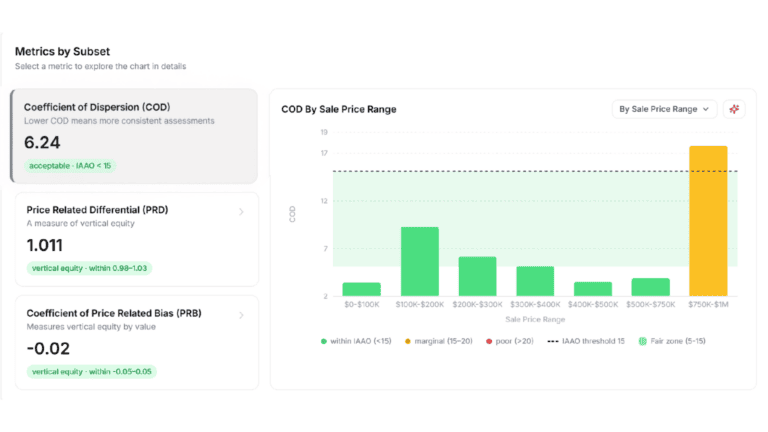
Image 1: COD by Grade
When a measure falls outside IAAO tolerance, the flag is immediate and unambiguous — no need to already know what a “good” Coefficient of Dispersion looks like to see something’s wrong.
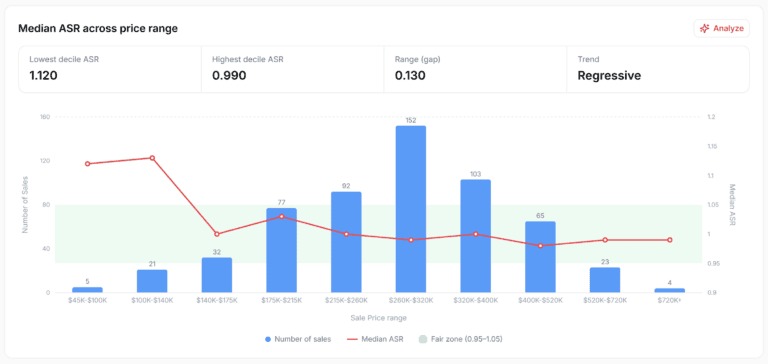
Image 2: Sales Ratio by Price Range
MA Copilot labels the trend in plain language — “Regressive” — so staff can recognize an equity problem without calculating it themselves first. Note that lower valued homes in this real-life example were over assessed.
The same principle carries into modeling. When MA Copilot generates a statistical model for a dataset, it explains in plain language why that model was chosen over the alternatives. An appraiser can see exactly which property characteristics contribute and by how much. That’s when their appraisal knowledge can be leveraged. The judgment that comes with the experience of knowing a neighborhood, recognizing when a statistical result doesn’t match local knowledge, and deciding what to investigate further.
What MA Copilot removes is the part of the job that was never really about appraisal expertise in the first place: needing a statistics background just to know whether your own numbers are sound.
Get an Early Look at Mass Appraisal Copilot
See how your team can uncover data issues, evaluate equity and understand performance faster. Complete the quick form to receive the latest product and launch updates.