
Inconsistent grades, incorrect property characteristics, missing values, overrides — most assessment offices aren’t short on effort. They’re short on visibility.
Many assessment offices believe their data is in reasonably good shape. Sales get verified, deeds get processed, values get generated, the reappraisal happens on schedule and the ratios look fine. But are they? Is the underlying data good or is there another layer of issues affecting the performance of your data?
Overrides, for example. Do you have “overrides” masking the problems? You needed to reduce the land value because the ratio was off and it worked. However, these are a temporary fix because if they get reset then the problem comes back. Also, how are they explained?
That gap doesn’t stay invisible forever. It surfaces at the worst possible times: mid-reappraisal, when a model behaves strangely and no one can say why; in an appeal hearing, when a property owner points out an inconsistency the office didn’t catch first; or in a state audit, when a pattern that’s been quietly accumulating for years finally gets flagged by someone outside the building.
The problem isn’t effort. It’s visibility.
While staff are extremely busy, auditing data for consistency is a separate task entirely, one that requires either dedicated time nobody has or a tool built specifically to do it. Without that, errors don’t get caught because they don’t get looked for. It’s not negligence. It’s bandwidth. Maintaining consistency with characteristics such as grades, especially when there are a lot of them with very little difference, is a challenge for assessment offices and appraisers. “Is it an ‘A’ grade for this part of town or across the county?”
Small inconsistencies compound at scale
A single mismatched record rarely matters on its own. The risk is in the pattern. Take a neighborhood where construction grades were applied inconsistently over the years, with some graded higher than others with no clear reason why. This sort of error is harder to identify because it’s an inconsistency rather than a value being missing or being too high or low. But it directly undermines equity, the standard every jurisdiction is measured against: similar properties should land at similar values. When grading drifts unnoticed across hundreds of parcels, that standard quietly stops being true, long before anyone catches it.
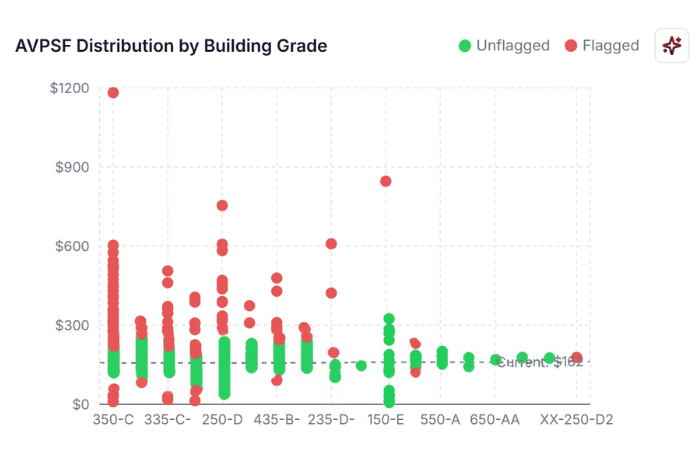
Image: Flagged Inconsistent Grades
Flagged parcels (red) show how much assessed value per square foot can vary within a single grade band — a spread that’s invisible in a CAMA system but obvious once visualized.
The appeals season blind spot
This is where dirty data stops being a housekeeping issue and starts being a liability. An appeal doesn’t ask “Did the appraiser work hard this year?” — it asks “is this value correct, and can you explain it?” If the underlying property record has an error the office never caught — a component value that doesn’t reconcile, an effective year built that predates original construction, a grade nobody re-checked in a decade — that’s not a defensible position. It’s a data problem now dressed up as a valuation dispute, and it’s far harder to unwind after the fact than it would have been to catch in advance.
Bringing visibility in-house, without adding headcount
This is a problem Mass Appraisal Copilot (MA Copilot) is built to address. Find issues, flag to staff, suggest fixes before the reappraisal, not after an appeal surfaces it. Rather than relying on staff to manually query records or wait for a problem to announce itself, MA Copilot runs a standing set of automated data quality checks scanning for the exact kind of inconsistencies that erode equity and complicate appeals: inconsistent grades, erratic effective year built values, construction attributes that don’t logically reconcile, components that don’t add up to the total assessed value, records with missing or impossible characteristics.
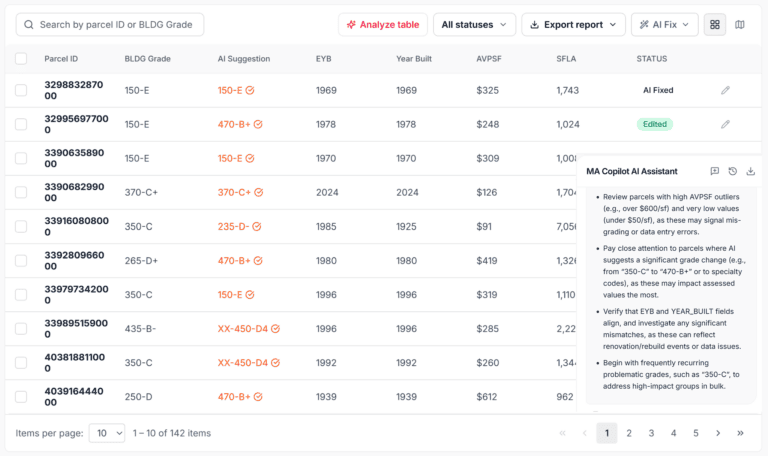
Image: Errors with AI suggested fixes and associated commentary
Every flagged parcel gets a suggested correction and a status — AI Suggestion, Fixed, Edited, or Active — so appraisers work from a queue instead of hunting for problems one by one.
Each flagged issue comes with a failed-record count and priority, so staff can see at a glance where the biggest exposure is, rather than treating every flag as equally urgent. For grade inconsistencies specifically, MA Copilot goes a step further: it visualizes how construction grades are distributed across a neighborhood, flags properties that don’t fit the pattern, and suggests a corrected grade based on the surrounding data — viewable on a map, and adjustable by the appraiser before anything is committed back to the CAMA system.
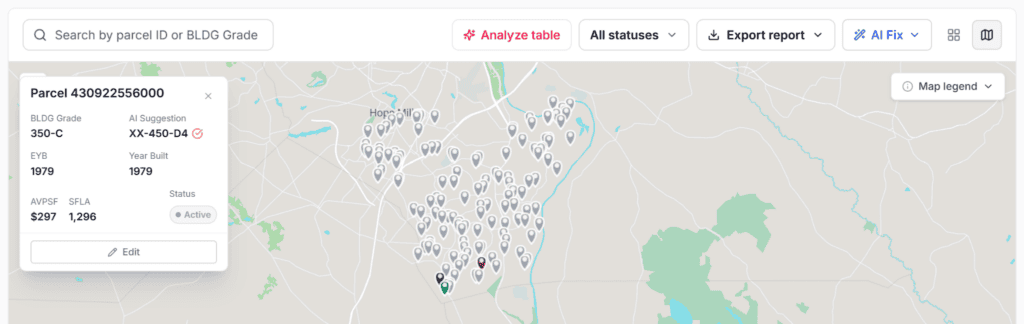
Image: Location of Errors
Grade outliers are mapped geographically, so an appraiser can tell at a glance whether a flagged parcel is a data error or a legitimate exception (like a lakefront lot) before making a change.
None of this replaces professional judgment. An appraiser still decides whether a flagged record is genuinely wrong or has a legitimate explanation — a lakefront lot that really does justify a grade outlier, for instance. What changes is that the office is making that call on purpose, with the full picture in front of them, instead of finding out by accident during an appeal.
Get an Early Look at Mass Appraisal Copilot
See how your team can uncover data issues, evaluate equity and understand performance faster. Complete the quick form to receive the latest product and launch updates.